
How to Choose the Right Window Tint for Your Property
TL;DR:
- Choosing the right window film depends on your specific climate, needs, and priorities, such as heat control, privacy, or security. Proper assessment ensures outdoor exposure, building type, and aesthetic preferences are balanced for optimal performance and compliance. Consulting with local experts and reviewing actual samples helps property owners make informed decisions tailored to their regional environment and individual goals.
New England's weather is a study in extremes. Southern New Hampshire and Greater Boston homeowners and business owners wrestle with blazing July heat, bitter January cold, and everything in between, which means choosing the wrong window tint can cost you comfort, money, and peace of mind all at once. The right film, on the other hand, transforms your windows into a genuine asset. Understanding seven core factors before you commit makes the difference between a decision you'll celebrate and one you'll regret by the next summer.
Table of Contents
- Understand your goals: Needs assessment for tinting
- Factor #1: Climate impact and energy efficiency
- Factor #2: Security and safety considerations
- Factor #3: Privacy, light, and aesthetics
- Comparison table: Matching tints to your priorities
- Making your final selection: Local insights & expert guidance
- Expert perspective: Why one-size-fits-all never works in window tinting
- Next steps: Smart window tinting for your home or business
- Frequently asked questions
Key Takeaways
| Point | Details |
|---|---|
| Match film to your needs | Start with your key goals—energy savings, privacy, safety, or looks—to identify the right window tint. |
| Local climate impacts choice | Choose a film that handles both hot summers and cold winters for best year-round comfort. |
| Prioritize expert guidance | Professional advice ensures you get the best results, in line with local codes and building type. |
| Compare types effectively | Side-by-side comparisons help you weigh features and tradeoffs quickly. |
| See before you buy | Use online tools or samples to visualize how a tint will affect your home or business. |
Understand your goals: Needs assessment for tinting
Before you look at a single product spec sheet, you need to get honest about what you actually want your windows to do. Choosing the right window film improves comfort, privacy, security, and energy savings simultaneously, but only when the film matches your specific priorities. Trying to solve every problem with one generic product almost always leaves you disappointed in at least one area.
Here are the most common goals property owners bring to us, and the film category that best matches each one:
- Heat and glare control: Solar control films are designed specifically for this. They reduce the amount of solar energy passing through the glass without making rooms feel like a cave.
- UV protection: Nearly all quality films block 99% of ultraviolet rays, which protects flooring, furniture, and artwork from fading over time.
- Privacy: One-way and reflective films create daytime privacy while still letting natural light in. Decorative films offer privacy around the clock.
- Security: Safety and security films hold broken glass in place, slowing forced entry and reducing injury risk from shattered panes.
- Aesthetics: Decorative and frosted films add a design element that blinds and curtains simply cannot replicate.
The mistake most people make is treating this as an either/or exercise. You don't have to choose between privacy and heat control. But you do need to rank your priorities so that your installer can recommend a film that delivers your top needs without unnecessary compromises on the rest.
Pro Tip: Write down your top three goals before your consultation. This single step saves time and immediately narrows your options to products that actually fit your situation.
Factor #1: Climate impact and energy efficiency
Once you've pinpointed your main needs, the local environment is the first key technical factor to address. Southern New Hampshire and Greater Boston experience both demanding summers and cold winters. That dual challenge shapes everything about which film will actually perform for you year-round.
During summer, south and west-facing windows funnel enormous amounts of solar heat into your rooms. Your air conditioning system has to fight that heat load constantly, which drives up your utility bills noticeably. Heat-blocking tints reduce cooling costs and protect interiors from sun damage at the same time. The right solar control film can reject up to 80% of solar heat energy before it ever enters the room, which translates directly into measurable savings on your cooling bills.
But here's where New England is different from, say, Florida. Our winters are genuinely cold, and some homeowners worry that a high-performance solar film will also block passive solar warmth in January. Modern low-emissivity (low-e) films are engineered to balance this tradeoff. They reject summer heat while still allowing some infrared warmth on cold sunny days. That distinction matters more in our climate than almost anywhere else in the country.
Key climate-related factors to weigh:
- Window orientation: South and west-facing glass gets the most direct sun and benefits most from solar control films.
- Existing glazing: Single-pane windows gain the most from film. Double-pane windows still benefit, but film selection requires more care to avoid thermal stress (heat buildup between panes).
- Building type: Commercial spaces with large glass facades face higher heat loads than most residential properties and typically see faster payback on energy-efficient films.
You can even use a window tinting energy savings calculator to estimate your specific return before making any commitment.
Pro Tip: For properties in Southern NH and Greater Boston, ask your installer specifically about year-round performance metrics, not just summer heat rejection numbers. A film that shines in July but hurts you in February is not the right fit for our region.
Factor #2: Security and safety considerations
Energy and comfort matter, but safety and security features should never be underestimated. Window glass is the most vulnerable point on most buildings, and that vulnerability cuts two ways: forced entry and accidental breakage.
Security window film strengthens glass to prevent break-ins and injuries by holding shattered fragments together when glass breaks. Think of it as a strong, transparent membrane bonded to the inside of your glass. When someone throws a rock through a window or a storm drives debris into it, the film keeps the broken pieces from flying inward and turning into dangerous projectiles.
Here are the scenarios where safety and security film is worth every penny:
- Home break-ins: Smash-and-grab burglars depend on speed. A security film that holds glass together for 30 to 60 extra seconds is often enough to deter them entirely.
- Severe weather: Ice storms and nor'easters are a real concern in our region. Film-reinforced glass resists wind-driven debris better than unprotected glazing.
- Workplace accidents: Retail stores, schools, and offices with high foot traffic near glass partitions or storefronts benefit significantly from shatter resistance.
- Graffiti protection: Specialized sacrificial films protect exterior glass surfaces from etching and tagging, and they're replaced instead of the glass itself when damaged.
"Safety window film is one of the most cost-effective security upgrades available for any property. It doesn't announce itself to potential intruders, but it performs when it counts." This is a perspective shared consistently by building security professionals across the industry.
Explore the full range of security film options to understand which thickness and adhesive type fits your specific exposure and risk level.
Factor #3: Privacy, light, and aesthetics
With safety covered, it's time to think about appearance, privacy, and balancing daylight. These three elements are connected more closely than most people realize, and getting one wrong can undermine the others.
Privacy films work on a simple principle: they create a contrast difference between inside and outside. On a bright day, a reflective film makes your windows look like a mirror to anyone standing outside, while you see through them clearly from the inside. The tradeoff is that at night, when interior lights are brighter than the darkness outside, the effect reverses. This is a critical point that many property owners discover too late.
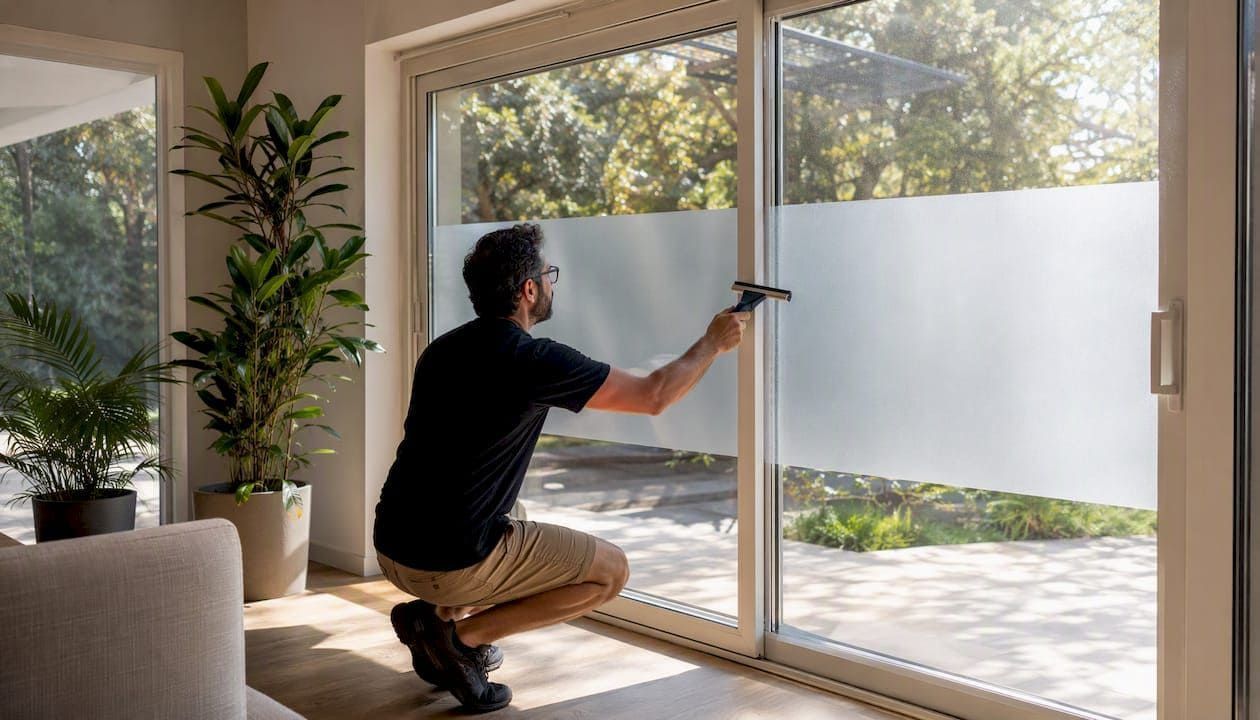
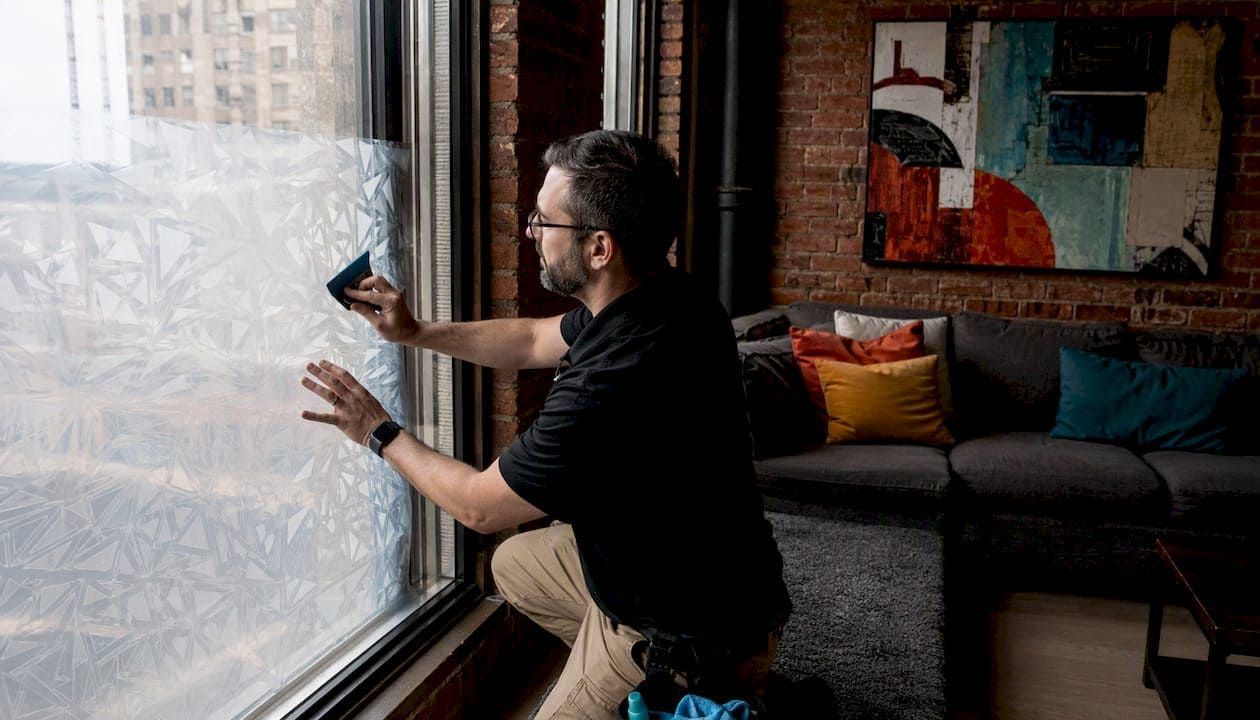
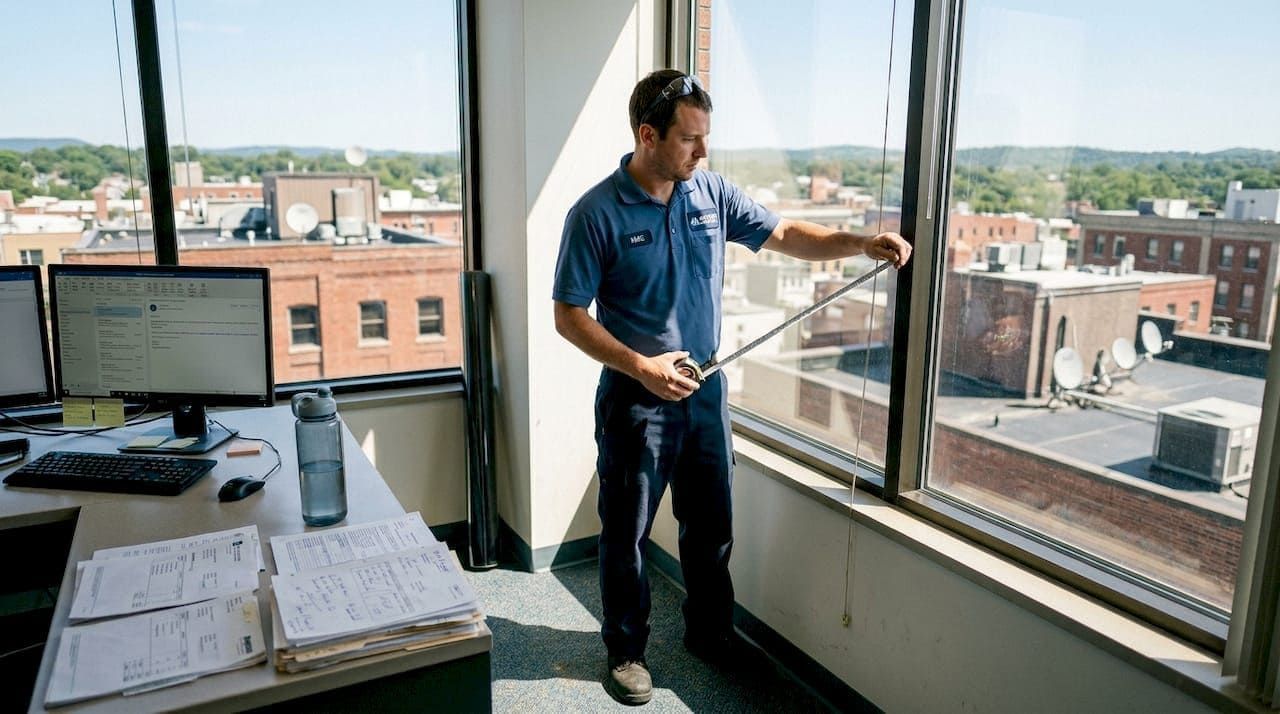
Decorative and privacy films can update interiors while increasing privacy in ways that blinds simply cannot. Frosted and etched-look films, for example, scatter light beautifully while blocking direct sightlines around the clock, not just during daytime hours. They're popular choices for bathroom windows, conference room glass walls, and street-facing retail spaces.
Key points on privacy, light, and aesthetics:
- Light transmission (VLT): This percentage tells you how much visible light passes through the film. A 70% VLT film is barely noticeable. A 20% VLT film creates a noticeably darker room.
- Reflectivity: High exterior reflectivity gives better daytime privacy but can create a "mirror" look that not everyone loves on a residential property.
- Decorative options: Gradient, geometric, and custom-cut patterns add genuine design value. They're often far less expensive than etched glass or frosted glass panels.
| Film type | Privacy level | Light transmission | Best use case |
|---|---|---|---|
| Clear security film | None | 90%+ | Safety without changing appearance |
| Lightly tinted solar | Low | 50 to 70% | Glare reduction, subtle look |
| Reflective solar | High (daytime) | 20 to 50% | Strong privacy, heat control |
| Frosted/decorative | High (all day) | Varies | Bathrooms, offices, storefronts |
| Dual-reflective | Medium to high | 30 to 60% | Balanced privacy day and night |
For more ideas, see options for improving window privacy and browse decorative window tinting ideas to see how film transforms spaces visually.
Comparison table: Matching tints to your priorities
You've learned about each factor. Now see the options compared side by side for quick reference.
The solar vs. privacy film comparison comes up constantly because these two categories serve overlapping but distinct needs. The best window tint depends on your unique blend of priorities , which is why a side-by-side view is so useful before you make a final call.
| Tint type | Primary benefit | Energy savings | Privacy | Safety | Ideal for |
|---|---|---|---|---|---|
| Solar control | Heat and glare reduction | High | Low to medium | None | Sun-facing windows, offices |
| Privacy/reflective | Daytime privacy | Medium | High | None | Street-facing residential, storefronts |
| Security/safety | Shatter resistance | Low | None | High | Ground floor, schools, retail |
| Decorative/frosted | Aesthetics and privacy | Low | High (all times) | Low | Bathrooms, conference rooms |
| Dual-reflective | Balanced performance | Medium to high | Medium | None | Homes with mixed exposure |
This table gives you a starting framework, but real-world selection depends on factors like your window's existing glass type, your building's orientation, and local building codes. No table can replace a conversation with a professional who has assessed your actual property.
Making your final selection: Local insights & expert guidance
After comparing your options, here's how to confidently make your tinting decision without second-guessing yourself afterward.
- Gather your priorities list. Revisit the goals you identified in the first section. Keep your top three in front of you.
- Assess each window individually. Different exposures, floors, and uses call for different films. A north-facing bedroom may need nothing more than UV protection, while a south-facing living room might need serious heat rejection.
- Check local codes and HOA rules. Some municipalities and associations have restrictions on reflectivity levels, especially for exterior-facing glass. This is more common in commercial applications but affects residential properties too.
- Request samples. Any reputable installer will provide physical film samples and show you how they look on your actual glass in your actual lighting conditions.
- Ask about warranties. Quality films like LLumar Vista Films carry manufacturer warranties that cover peeling, bubbling, and color change. Know what's covered before you sign.
- Get a professional estimate. Professional consultation ensures your tint choice fits your building's needs and local regulations, and it costs you nothing upfront.
For more practical inspiration, reviewing recent window tinting projects shows how film performs on real properties in our region, which is far more instructive than looking at idealized product photos. Also consider whether reducing heat and glare is your dominant motivation, as it often points you directly to the right film family quickly.
Pro Tip: Always ask to see a virtual preview of the film on your specific property. Many professional installers offer digital viewer tools that let you see what different films will look like before any work begins.
Expert perspective: Why one-size-fits-all never works in window tinting
Here's something professionals wish more people understood before they start browsing products online: the best window tint for your neighbor's house is often not the right tint for yours, even if you share the same street.
Window tinting decisions are deeply contextual. A Victorian-style home with single-pane windows on a north-facing lot in Manchester, NH has genuinely different needs from a modern glass-heavy commercial building on the south side of Boston. Applying the same film recommendation to both would be a disservice to both property owners.
Regional climate is just one layer of this. Building orientation, glass type, interior use, occupant lifestyle, and even the color of your building's exterior all influence which film performs best. We've seen properties where a popular solar control film created more problems than it solved because nobody accounted for the existing double-pane units and their risk of thermal stress.
Generic online guides are useful for building vocabulary and understanding your options. But they cannot substitute for key window film factors being evaluated in person by someone who has installed film on hundreds of properties in your specific region.
The most common mistake we see is property owners selecting a film based on appearance alone, then discovering it either doesn't deliver the performance they expected or creates an unexpected problem like reduced visibility at night or excessive reflectivity that their HOA flags. A personalized assessment catches those issues before they become expensive regrets.
Next steps: Smart window tinting for your home or business
If you're ready to act on these key factors, here are the smartest next steps to take.
Start by exploring what film actually looks like on your property before anyone shows up with a roll. The residential film viewer tool and the commercial film viewer tool let you preview different film options on representative property images so you can build confidence in your direction before committing.
When you're ready to move forward, scheduling a free home tinting estimate with Surface Dynamics Window Tinting is the logical next step. As an exclusive LLumar SelectPro Dealer serving Southern New Hampshire and Greater Boston, we bring genuine regional expertise to every assessment. We evaluate your windows, your goals, and your building's specific conditions, then recommend the LLumar Vista Film products that fit your situation rather than just the ones that are easiest to install.
Frequently asked questions
What type of window tint is best for heat reduction?
Solar control film is the top choice for reducing heat, particularly on south and west-facing windows where direct sun exposure is greatest. Heat-blocking tints reduce cooling costs and protect your interiors from sun damage at the same time.
How do I know if a window tint meets local codes?
Local building and HOA codes vary by municipality, especially regarding exterior reflectivity. Professional consultation ensures your tint choice fits your building's needs and local regulations so you avoid costly compliance issues after installation.
Are privacy tints still effective at night?
Most reflective privacy films rely on the brightness contrast between outside and inside to work, meaning they lose effectiveness when your interior lights are brighter than the exterior. Decorative and privacy films like frosted or etched-look options provide around-the-clock privacy regardless of lighting conditions, making them a better fit when nighttime privacy is a priority.
Can window film really prevent break-ins?
Security window films do not make glass unbreakable, but security window film strengthens glass significantly by holding shattered fragments together, which delays forced entry by enough time to deter most smash-and-grab attempts and substantially reduces the risk of injury from broken glass.
Recommended