
Streamline building energy efficiency: A step-by-step workflow
TL;DR:
- Following a structured energy efficiency workflow—benchmarking, auditing, planning, implementing, and verifying—ensures maximum savings from upgrades. Professional solutions like window film provide high payback and are best applied early in the process. Proper sequencing and verification prevent missed opportunities and costly setbacks in building retrofit projects.
Energy waste is one of the costliest problems facing homeowners and commercial property managers in Southern New Hampshire and Greater Boston, yet most people address it by grabbing whatever upgrade seems popular without ever following a real plan. The result is scattered improvements, disappointing utility bills, and money left on the table every single month. Following a proven, sequential workflow changes everything. When you benchmark first, audit second, implement in the right order, and verify results at the end, every dollar you invest works harder and every upgrade builds on the last. Professional solutions like window film installation fit naturally into this process and frequently deliver some of the fastest payback of any measure on the list.

Table of Contents
- Understand the building energy efficiency workflow
- Assess your baseline: Benchmarking and past utility data
- Audit and identify energy conservation measures (ECMs)
- Implement and sequence efficiency upgrades for best results
- Measure and verify your savings: Monitoring and compliance
- A smarter path: Lessons from real-world retrofit failures
- Take the next step: Expert window tinting solutions for your building
- Frequently asked questions
Key Takeaways
| Point | Details |
|---|---|
| Follow a proven sequence | Benchmarking, auditing, planning, implementing, and verifying upgrades produces the highest energy and cost savings. |
| Use real data to measure | Always track your actual energy use before and after upgrades to verify true results and make future improvements. |
| Prioritize professional solutions | Professional audits and expert window tinting achieve more reliable, faster payback compared to DIY or scattered upgrades. |
| Local programs provide support | Programs like Mass Save offer qualified help and incentives for Massachusetts residents and property managers. |
| Verification prevents waste | Measure and verify your savings so that modeled energy improvements become real, lasting benefits for your property. |
Understand the building energy efficiency workflow
A clear workflow exists for a reason: it keeps you from spending money on the wrong things at the wrong time. Whether you manage a commercial office in Boston or own a home in Nashua, the stages are essentially the same.
The five core workflow stages are:
- Benchmarking — Record your current energy use so you have a baseline to measure against.
- Auditing — Hire a qualified professional to inspect the building and find where energy is escaping.
- Planning ECMs — Develop a prioritized list of Energy Conservation Measures (ECMs) based on cost, savings, and payback period.
- Implementation — Install upgrades in the correct sequence to capture the maximum combined benefit.
- Measurement and Verification (M&V) — Track real-world results and confirm that the upgrades performed as expected.
Seattle's step-by-step benchmarking workflow confirms that a practical workflow starts with benchmarking, then audit, then plan and M&V. The order is not optional. Skipping ahead causes you to miss savings and creates compliance headaches if your property falls under local reporting laws.
| Stage | Commercial focus | Residential focus |
|---|---|---|
| Benchmarking | ENERGY STAR Portfolio Manager | Utility bills and EUI estimate |
| Audit | ASHRAE Level I, II, or III | Home energy audit or blower door test |
| ECM planning | ROI ranked list, capital budget | DIY vs. contractor, incentive programs |
| Implementation | Sequenced by trade and payback | Priority by season and budget |
| M&V | Annual BERDO or similar reporting | Monthly bill tracking |
You can use our energy savings calculator to get a quick sense of projected savings before you even hire an auditor. For a deeper look at the commercial side of this process, our commercial workflow guide walks through specific building scenarios step by step.
Assess your baseline: Benchmarking and past utility data
You cannot improve what you do not measure. That sentence sounds simple, but most failed retrofit projects fail precisely here: the owners never established a clear starting point, so they have no way to know whether their upgrades actually worked.
Benchmarking means collecting your energy consumption data and expressing it in a way that allows comparison. The most useful metric is EUI, or Energy Use Intensity , which equals the total energy used per square foot per year. A lower EUI means a more efficient building. Seattle's step-by-step benchmarking workflow recommends using ENERGY STAR Portfolio Manager and EUI as your primary benchmarks.
For commercial properties, ENERGY STAR Portfolio Manager is a free online tool that accepts your utility data and scores your building on a 1 to 100 scale. A score of 75 or higher qualifies for ENERGY STAR certification, which is meaningful for leasing and property value. For residential properties, the same EUI concept applies, though most homeowners simply track monthly kilowatt hours and gas therms from their bills.
What to gather before benchmarking:
- At least 12 months of utility bills (electric, gas, and any fuel oil or propane)
- Your building's gross square footage
- Occupancy hours and occupant count (for commercial)
- Any major equipment changes in the past year
For Boston area property owners, BERDO (Boston's Building Emissions Reduction and Disclosure Ordinance) requires annual reporting for buildings over 20,000 square feet. Collecting your utility data in ENERGY STAR Portfolio Manager simultaneously satisfies your BERDO submission requirements, so you are working double duty with one task.
Pro Tip: If your utility provider offers automatic data upload to ENERGY STAR Portfolio Manager, enable it immediately. This saves hours of manual entry and reduces the chance of input errors that could distort your baseline.
For homeowners trying to understand where to start, resources on energy efficient home design can help frame what a realistic savings target looks like before you even open your first utility bill. You can also use our home energy calculator to see what window film alone could save you annually.
Audit and identify energy conservation measures (ECMs)
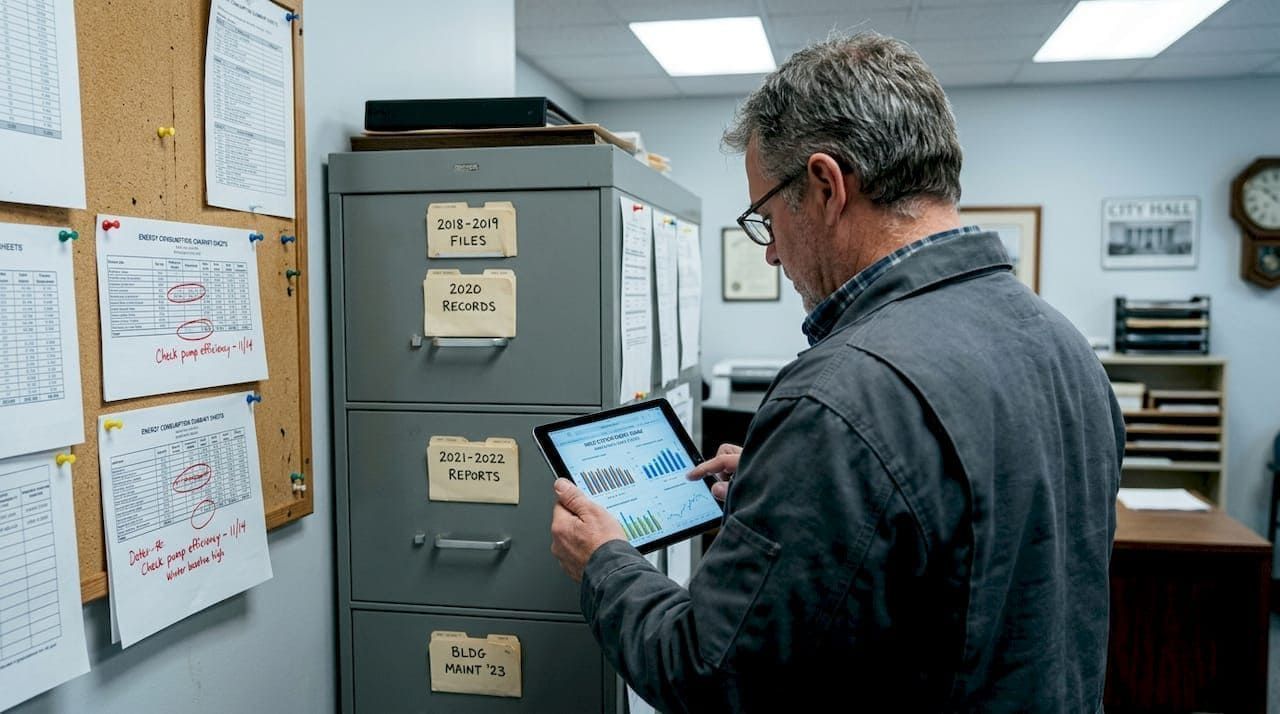
Once your baseline is locked in, you need a professional set of eyes on the building. An energy audit is not just a walk-through. It is a systematic inspection that identifies every place your building loses energy and translates those findings into a ranked list of ECMs with estimated costs and payback periods.
ASHRAE audit levels explained:
- Level I (Walk-through) — A basic visual inspection that identifies obvious issues and rough savings potential. Best for initial screening.
- Level II (Energy survey and analysis) — A detailed inspection with energy modeling. This is the most common level for residential and small commercial buildings. It produces a full ECM list with costs and savings estimates.
- Level III (Detailed analysis) — A deep-dive with extensive data collection and computer simulation. Used for large commercial buildings or complex retrofit projects.
BERDO requirements note that ASHRAE audit level depth helps tailor recommendations, and that Mass Save is a key program for residential and commercial audits in Massachusetts. Mass Save is funded by the state's utilities and offers free or heavily subsidized audits for both homes and commercial buildings. If you own property in Massachusetts, there is almost no reason to pay for an audit out of pocket.
"The audit is only as useful as the action plan it generates. A ranked ECM list with real payback numbers is what separates an audit from an inspection."
Common ECMs that auditors identify include:
- Air sealing and weatherstripping around doors and windows
- Attic and wall insulation upgrades
- HVAC controls, programmable thermostats, and equipment replacement
- Lighting upgrades from fluorescent to LED
- Solar control window film to reduce heat gain through glass
- Cool roofing or reflective coatings
Window tinting consistently appears as a high-value ECM because glass is one of the biggest thermal weak points in any building. Our energy efficiency tips for homeowners explain why windows are so often the fastest-payback upgrade on an ECM list.
For a clear look at why reducing solar heat gain matters beyond just comfort, read about how heat reduction affects energy savings. The numbers are often surprising. You can also find easy conservation steps that pair well with a formal audit for homeowners who want to get started right away.
Pro Tip: When reviewing your audit report, ask the auditor to separate ECMs by simple payback period. Any measure under three years should go to the top of your implementation list.
Implement and sequence efficiency upgrades for best results
Sequencing matters more than most people realize. Installing a new HVAC system before air sealing the building means your new system is now sized for a leaky envelope and will never reach its rated efficiency. Getting the order right is not a minor detail. It determines how much you actually save.
The general rule for sequencing ECMs:
- First: Reduce the load (air sealing, insulation, window film)
- Second: Right-size or upgrade mechanical systems (HVAC, ventilation)
- Third: Optimize controls and automation (smart thermostats, building automation)
- Fourth: Renewable energy (solar panels sized to the now-reduced load)
Window film fits firmly in that first category. It directly reduces the solar heat entering through glass, which lowers the peak cooling load on your air conditioning system. Adopting a standardized, sequenced program from audit through implementation and into verification prevents under-scoped audits and closes the gap between projected and actual savings.
| ECM type | Typical payback period | Sequencing priority |
|---|---|---|
| Air sealing | 1 to 2 years | First |
| Window film | 2 to 4 years | First to second |
| LED lighting | 2 to 3 years | First to second |
| HVAC upgrade | 5 to 10 years | After envelope work |
| Building automation | 3 to 5 years | After mechanical |
| Solar PV | 7 to 12 years | Last |
What to look for when hiring a contractor:
- Verified credentials and manufacturer certifications (such as LLumar SelectPro dealer status for window film)
- Insurance and local licensing for your specific state (New Hampshire and Massachusetts have different requirements)
- A written scope of work with projected performance outcomes
- References from similar projects in your region
Our article on why window tinting matters for energy savings breaks down exactly what you can expect from professionally installed solar control film in a New England climate. If you are managing a commercial property and wondering whether your building has already outgrown its current glass performance, check our guide on signs your building needs solar film upgrades.
Measure and verify your savings: Monitoring and compliance
Implementation without verification is just spending money and hoping. Measurement and Verification, or M&V, is the formal practice of comparing your post-upgrade energy use against your pre-upgrade baseline to confirm real-world savings. Many property owners skip this step because it feels like paperwork, but it is actually where you find missed opportunities and confirm your investment paid off.
A simple M&V process for homeowners and managers:
- Set your baseline. Use your benchmarked EUI from before the upgrades.
- Establish a monitoring period. Track at least 12 months of post-upgrade utility data.
- Normalize for weather. Use heating and cooling degree days to account for year-to-year temperature differences.
- Calculate savings. Compare normalized post-upgrade consumption to the baseline.
- Report if required. Boston area properties covered by BERDO must submit annual reports through ENERGY STAR Portfolio Manager.
Seattle's step-by-step benchmarking workflow establishes that M&V via IPMVP (International Performance Measurement and Verification Protocol) methodology ensures that modeled energy savings match real performance. For most residential and small commercial projects, a simplified version of this protocol works perfectly well.
For a deeper look at practical M&V strategies, our resource on M&V best practices shows how to connect performance tracking to each specific upgrade you installed.
Pro Tip: Set a calendar reminder for three months after any major upgrade to pull your first post-installation bill. Early data often reveals unexpected issues, like a contractor left a setting wrong, before they compound into a full year of missed savings.
A smarter path: Lessons from real-world retrofit failures
After seeing many building retrofit projects across Southern New Hampshire and Greater Boston, one pattern stands out. The projects that fall short almost never fail because of bad products or poor installation. They fail because someone skipped a step.
The most commonly skipped step is verification. An owner installs new windows, new film, and a new HVAC system, then moves on to the next project without ever checking the numbers. Six months later, the utility bills improved, but only modestly, and nobody knows why the savings fell short of projections. Without a baseline and a monitoring plan, there is no way to diagnose the gap.
The second most common failure is what we call "shiny object syndrome." A building manager reads about a new smart building technology and wants to skip straight to building automation without first sealing the air leaks or addressing the sun-baked south-facing windows. Smart controls on an inefficient building just automate the inefficiency.
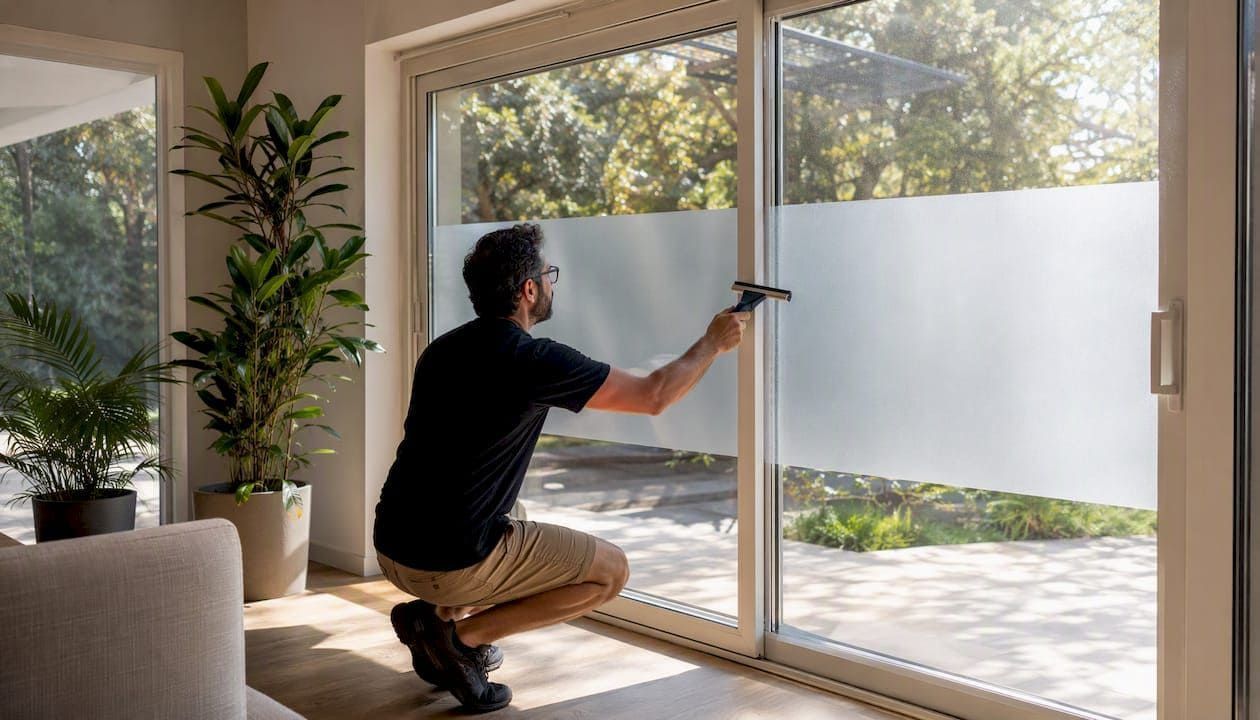
Here is the counterintuitive insight: some of the highest-impact upgrades are also the simplest to install. Window film is a perfect example. It goes on in a single day, requires no structural changes, and immediately starts reducing heat gain and UV exposure every time the sun shines. It is not glamorous, but it consistently delivers. Our commercial window tinting workflow guide documents exactly this kind of straightforward, high-return outcome.
The teams that succeed are the ones who follow the workflow without shortcuts, get the basics right first, and only move to complex technologies after the fundamentals are locked in. That approach is not complicated. It just requires discipline.
Take the next step: Expert window tinting solutions for your building
You now have a clear picture of how a building energy efficiency workflow operates from baseline to verified savings. The next move is putting that knowledge into action with professional support.
At Surface Dynamics Window Tinting, we work with homeowners and commercial property managers across Southern New Hampshire and the Greater Boston Area to install LLumar SelectPro solar control films that deliver measurable reductions in heat, glare, and energy costs. As an exclusive LLumar SelectPro Dealer, we bring manufacturer-certified expertise and premium Vista Films to every project. You can request a free window tinting estimate and get a clear picture of projected savings before you commit. Want to see finished results first? Browse our commercial photo gallery or our residential photo gallery to see how professional installation transforms real buildings just like yours.
Frequently asked questions
What is the most important first step in any building energy efficiency workflow?
Benchmarking your current energy use is the essential starting point, because EUI and ENERGY STAR Portfolio Manager give you the baseline needed to measure every future improvement accurately.
How can I know which upgrades will have the highest impact?
A professional energy audit produces a ranked list of ECMs with projected costs and payback, and audit-generated ECM rankings are the most reliable way to prioritize your investment.
Is window tinting a good early ECM for homes and offices?
Yes, window tinting is often a cost-effective first upgrade because it requires no structural changes, installs in a single day, and immediately reduces solar heat gain and UV exposure.
How do I verify that my energy upgrades actually worked?
Track monthly utility bills after installation, normalize for weather differences, and use tools like ENERGY STAR Portfolio Manager and M&V protocols to confirm actual savings against your pre-upgrade baseline.
Are there local programs that can help pay for or evaluate energy upgrades?
Yes, Mass Save provides qualified audits and incentives for both residential and commercial properties in Massachusetts, often at little or no cost to the building owner.
Recommended