
How to Block UV Without Darkening Your Windows
Clear, professional-grade UV window films can block a very high percentage of harmful ultraviolet radiation while keeping your rooms bright and your view completely intact. The Skin Cancer Foundation confirms that high-quality UV window films can block 99% or more of UVA and UVB, and recommends products that provide data showing that level of performance. You don't have to choose between sun protection and natural light.
Here's what that means in practice:
- UV rejection tells you how much ultraviolet the film stops. Look for very high percentages across the 300–380 nm range.
- Visible Light Transmittance (VLT) tells you how much daylight still comes through. A clear UV film typically allows a large majority of visible light, meaning the room looks almost unchanged.
- Film type matters. Clear UV films, spectrally selective films, and ceramic films are the categories that deliver high UV rejection without noticeably darkening a space.
Pro Tip: Ask any installer for the product datasheet before signing anything. If a film is marketed as "UV-blocking" but the sheet doesn't list a specific rejection percentage and wavelength range, treat that as a red flag.
Key Takeaways
Clear and spectrally selective UV window films can block 95–99%+ of harmful ultraviolet radiation while maintaining high visible light transmittance, delivering UV protection without darkening your rooms.
| Point | Details |
|---|---|
| UV rejection vs. VLT | These are independent specs; a 99% UV-blocking film can still pass 90% of visible light. |
| Best film types | Clear UV, spectrally selective, and ceramic films deliver UV protection without noticeably darkening a room. |
| Wavelength coverage | Confirm the spec sheet covers 300–400 nm; some products exclude 380–400 nm from their reported figures. |
| Verify with a meter | Ask for pre- and post-install UV meter readings; the NPS targets 50 µW/lumen or lower for museum-grade protection. |
| Surfacetint | Provides on-site UV measurement, LLumar SelectPro film installation, and post-install verification for homes and commercial properties in Greater Boston and Southern NH. |
Table of Contents
- What Does Ordinary Glass Actually Block? UVA vs. UVB Explained
- How Clear Window Films Stop UV While Letting Visible Light Through
- Which Film Types Block UV Without Noticeably Darkening a Room?
- Will a UV-Blocking Film Darken Your Room?
- Installation Choices: Interior vs. Exterior, DIY vs. Pro, and What to Expect
- How to Verify UV-Blocking Performance Before and After Install
- What Museum Conservation Standards Teach Homeowners About Film Testing
- Why Installers Favor Clear and Spectrally Selective Films for Daylight-First Clients
- Surfacetint Offers On-Site UV Measurement and Professional Installation
- Sources
What Does Ordinary Glass Actually Block? UVA vs. UVB Explained
Most people assume their windows already filter out the sun's harmful rays. They block some, but not the ones that matter most indoors.
Standard window glass blocks nearly all UVB radiation below about 330 nm. The International Ultraviolet Association explains that ordinary glass transmits most long-wave UVA above that threshold, which is exactly the wavelength range that reaches your furniture, floors, and skin every day. UVB causes sunburn quickly and is largely stopped at the glass. UVA penetrates deeper into skin tissue and is the primary driver of indoor fading and cumulative UV exposure.
Why does that distinction matter for film selection?
- UVA (315–400 nm): Long-wave, passes through standard glass, causes fading and skin aging.
- UVB (280–315 nm): Shorter-wave, mostly blocked by glass already.
- The gap: Films need to cover the UVA range your glass misses, particularly 330–400 nm.
UV-induced photochemical reactions break down dyes and pigments in fabrics, artwork, and wood finishes. A dedicated UV film targets the wavelengths your glass lets through.
A note on fading: According to FSEC research on windows and fading, visible light and infrared heat also contribute to fading. Blocking UV addresses the most aggressive cause but does not completely stop fading from bright sunlight. Clear UV films slow the process significantly; they don't eliminate it entirely.
How Clear Window Films Stop UV While Letting Visible Light Through
The physics here is more elegant than it sounds. A film that looks clear to your eye is doing something very specific: it absorbs or reflects ultraviolet wavelengths while passing the visible spectrum (roughly 380–700 nm) almost untouched.
Museum conservation research on UV-filtering films explains that non-metallic films rely on organic UV-absorbing compounds embedded in the polyester film body. Compounds like benzotriazoles, hydroxybenzotriazines, and oxalanilides absorb UV energy and convert it to low-level heat rather than letting it pass through. Because these molecules are tuned to ultraviolet wavelengths, they don't interfere with visible light.
Film construction typically looks like this, from exterior to interior:
- Glass surface (existing window)
- Adhesive layer (bonds film to glass; may contain UV absorbers)
- Polyester film body (primary UV-absorber location; one or more layers)
- Hard coat or scratch-resistant layer (outermost surface facing the room)
Where the UV absorbers sit matters. When they're concentrated in the film body rather than just the adhesive, the protection tends to be more uniform and longer-lasting. As Achilles USA notes, high-performance clear films can be formulated to block up to around 99% of UV while preserving optical clarity.
Which Film Types Block UV Without Noticeably Darkening a Room?
Not every UV-blocking film is designed to preserve daylight. Tinted and reflective films trade visible light for heat and glare control. For homeowners who want UV protection without tint, four categories deliver:
The IWFA's Advanced Solar Control Education Guide highlights spectrally selective films as the best balance for homeowners who want heat and UV control without substantially changing daylight appearance. Some advanced products in this category report UV transmittance reductions approaching 99.9% in testing.
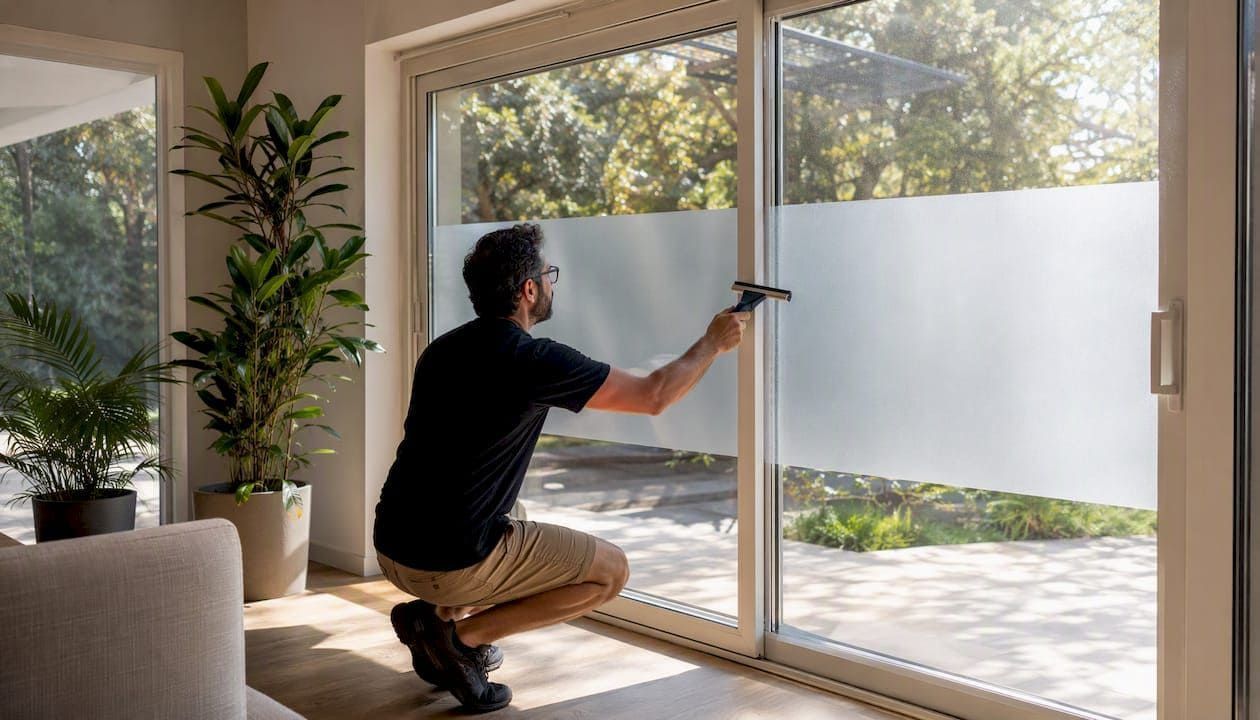
For pure UV blocking with maximum visible light, a clear UV film is the right call. You'll see real residential examples of how these films look installed on home windows. The difference between a clear UV film and an untreated window is nearly undetectable to the naked eye.
When you also need heat and glare control, spectrally selective or ceramic films earn their slightly lower VLT. A 60% VLT film still lets in substantial daylight; most people describe the change as similar to wearing lightly tinted sunglasses indoors.
Pro Tip: For south- or west-facing rooms where summer heat is a real problem, a spectrally selective film often makes more sense than a pure clear UV film. You get UV protection plus meaningful heat rejection, and the VLT drop is usually less noticeable than you'd expect.
For a deeper look at each category, this guide to UV blocking film types covers the technical differences in detail.
Will a UV-Blocking Film Darken Your Room?
This is the question most homeowners ask first, and the answer depends entirely on which film you choose.
VLT and UV rejection are independent specifications. A film with 99% UV rejection can simultaneously have a 90% VLT, meaning 90% of visible light still passes through. The UV is blocked; the daylight isn't. That's the whole point of a spectrally selective or clear UV film.
Here's how VLT plays out in practice:
- 90% VLT: Virtually no perceptible change. The room looks the same; the UV protection is invisible.
- 70% VLT: A slight reduction in brightness, noticeable mainly when comparing directly to an untreated window.
- 50% VLT: Meaningful dimming, similar to a lightly overcast sky. Rooms still feel bright, but the change is visible.
- Below 40% VLT: Noticeable darkening. Appropriate for glare control or privacy, not for daylight-first installs.
The takeaway on fading: Even a 90% VLT clear UV film will significantly slow fading. FSEC's research confirms that UV is the most aggressive fading driver, so removing 99% of it makes a real difference even if visible light and heat still contribute modestly.
For rooms where you want to protect solar-exposed interiors without losing the feel of natural light, a clear UV or high-VLT spectrally selective film is the right specification to request.

Installation Choices: Interior vs. Exterior, DIY vs. Pro, and What to Expect
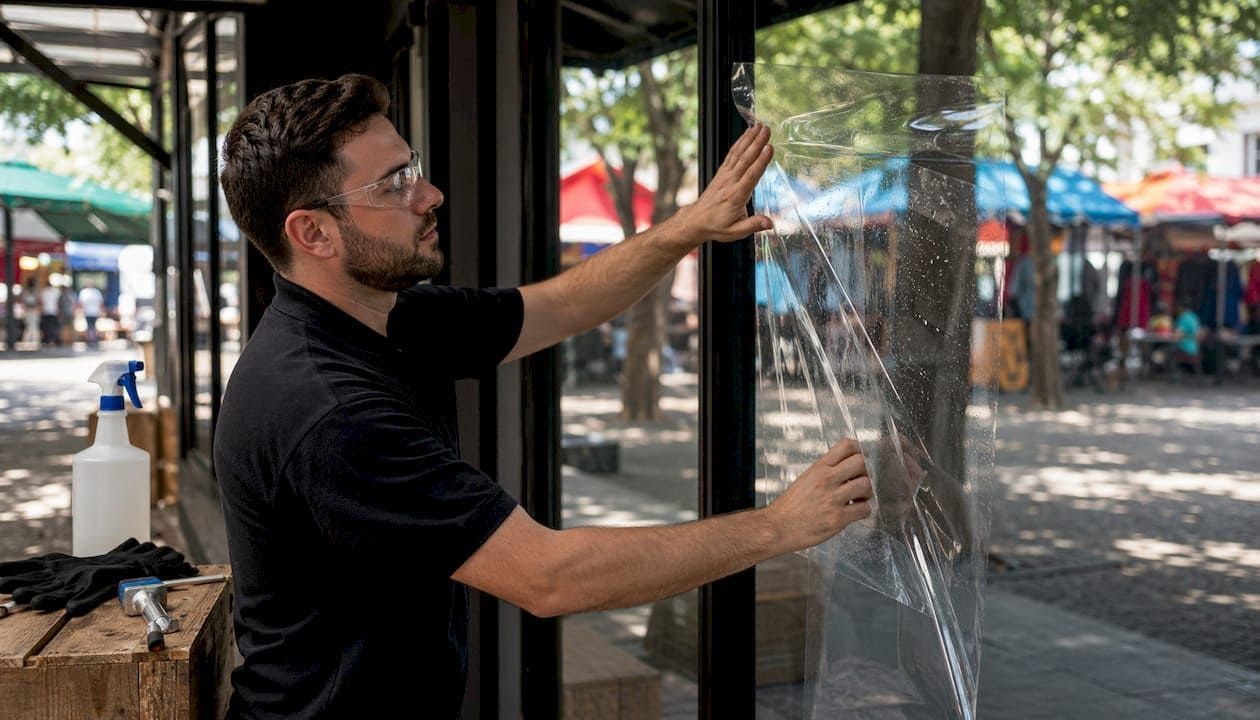
Most residential UV window films are applied to the interior glass surface. Interior application protects the film from weather, cleaning abrasion, and UV degradation, which is why interior films typically carry manufacturer warranties of 10–15 years. Exterior films exist and work well in specific situations, but they're more vulnerable to environmental wear and usually carry shorter warranties.
Key installation considerations:
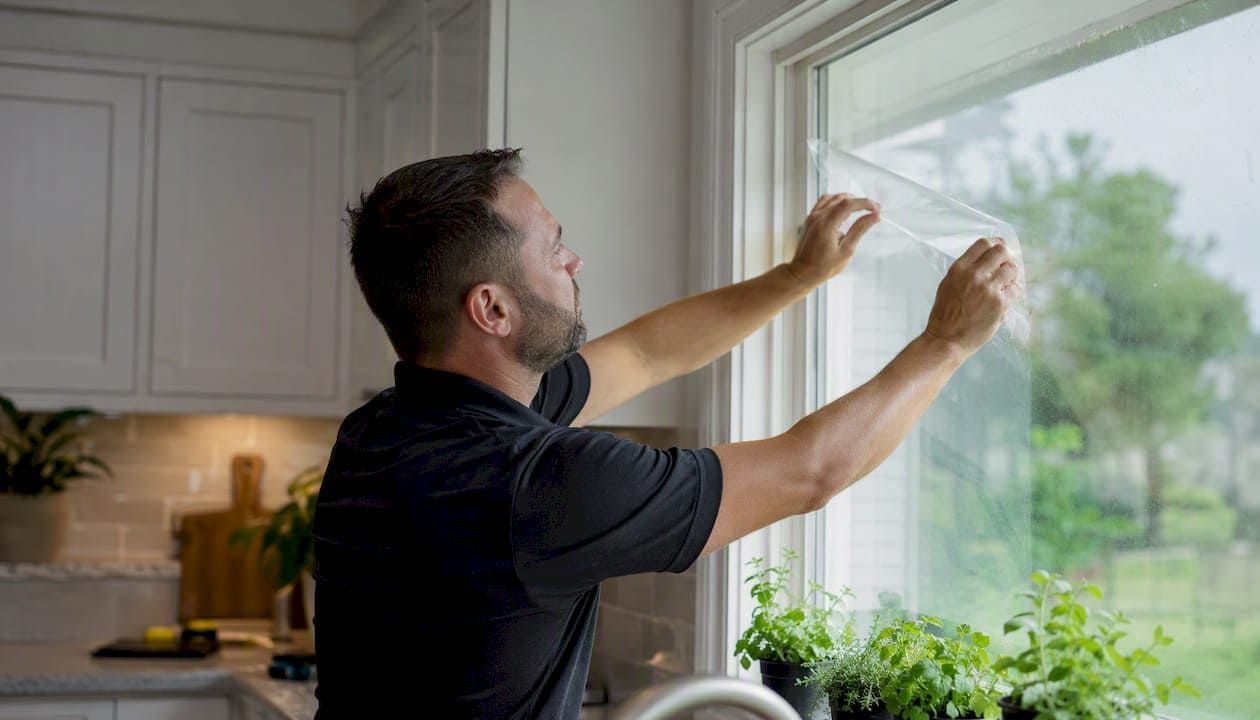
- Professional installation produces even adhesion, eliminates bubbles, and is required by most manufacturers to validate the warranty. A poorly applied film with air pockets or edge lifting will degrade faster and perform unevenly.
- Curing time runs from a few days to about a month depending on climate, film type, and glass orientation. During curing, small water bubbles are normal and will disappear.
- Glass stress risk is real with darker, heat-absorbing films on certain glass types. Clear UV films carry minimal thermal stress risk because they absorb very little solar energy. Tinted or reflective films on older or irregular glass need a professional assessment first.
- DIY kits are available, but the margin for error is significant. Misalignment, dust contamination, and uneven squeegee pressure all affect both appearance and performance.
The UV protection window tinting workflow walks through exactly what a professional installation visit looks like, from measurement to post-install verification.
How to Verify UV-Blocking Performance Before and After Install
Marketing claims are easy to make. Here's how to confirm a film actually delivers what the spec sheet promises.
- Request the product datasheet. It should list UV rejection percentage, the wavelength range tested (look for coverage through 380–400 nm), and VLT. If the datasheet only says "reduces UV" without a number, ask for a different product.
- Check the wavelength range. Some manufacturers report 99% UV rejection over 300–380 nm but exclude 380–400 nm from their figures. The IWFA education guide notes this gap matters for sensitive applications. Ask specifically whether the spec covers the full 300–400 nm range.
- Look for independent endorsement. The Skin Cancer Foundation's Seal of Recommendation goes to products that provide data showing 99%+ UV blocking. That seal is a meaningful third-party signal.
- Ask for a UV meter reading. A handheld UV meter (or spectrometer) can measure UV levels before and after film application. A reputable installer should be willing to document pre- and post-install readings.
- Request a sample test. Ask the installer to apply a small sample to one window and measure it before committing to a full install.
- Watch for red flags. Vague language like "UV reduction" or "UV protection" without a percentage, missing wavelength data, or no datasheet at all are signs the product's performance hasn't been independently verified.
For product-level examples, 3M's Solar Clear film explicitly lists 99.9% UV blocking on its product page alongside clarity and low-reflectivity specs. That's the kind of specific, documented claim worth asking for from any manufacturer.
Pro Tip: Bring a simple handheld UV meter to your installer consultation. They're inexpensive and give you a baseline reading before any film goes on. A good installer will welcome the verification step, not resist it.
What Museum Conservation Standards Teach Homeowners About Film Testing
Museums and archives set the most demanding UV protection standards in existence, and their testing protocols translate directly to what homeowners should ask for.
The National Park Service's Conserve O Gram recommends testing actual film samples with electronic meters because performance can vary by batch and by installation. A product's lab sheet may not reflect the installed result after accounting for adhesive, glass type, and installation technique. The NPS notes a target of about 50 µW/lumen or lower as a useful benchmark for museum-level UV protection.
What this means for a homeowner:
- Batch variance is real. Two rolls of the same film from different production runs can perform slightly differently. Meter-based verification after install catches this.
- Installation affects performance. Air pockets, uneven adhesion, or contamination between film and glass can reduce effective UV blocking in localized areas.
- Documented readings matter. Ask your installer to record UV meter readings at multiple points on the installed film, not just one spot near the center.
For rooms with valuable artwork, antique textiles, or photosensitive occupants, pairing UV film with fade-resistant fabric choices gives you layered protection. Film handles the UV; fabric selection handles the residual visible-light exposure.
Why Installers Favor Clear and Spectrally Selective Films for Daylight-First Clients
When a homeowner's primary goal is UV protection without losing natural light, experienced installers consistently reach for clear UV films or spectrally selective options. The reasoning isn't complicated: these films hit the UV target without creating thermal stress on standard residential glass, and they're the easiest sell to a client who's worried about darkening.
Spectrally selective films earn the recommendation when heat control is also on the table. They reject specific near-infrared wavelengths that carry heat while leaving visible light largely alone. The VLT trade-off is real but modest, and the comfort improvement in a west-facing room on a July afternoon is substantial.
Ceramic films are the choice when a client wants zero metallic appearance and minimal reflectivity. They perform comparably to spectrally selective films on UV rejection and carry a neutral look that works well on architectural glass where aesthetics matter.
During a site survey, a professional installer looks at glass type, frame condition, compass orientation, and shading from overhangs or trees. South- and west-facing glass in New England gets significantly more UV load than north-facing glass. That orientation data shapes the film recommendation more than most homeowners expect.
Surfacetint Offers On-Site UV Measurement and Professional Installation
Choosing the right film on paper is one thing. Knowing it's installed correctly and performing as specified is another.
Surfacetint serves residential and commercial properties across Southern New Hampshire and the Greater Boston Area as an exclusive LLumar SelectPro Dealer. Every consultation includes an on-site assessment: glass type, sun exposure, and UV meter readings before any film goes on. After installation, post-install verification confirms the film is performing to spec. You get documented UV rejection numbers, not just a manufacturer's promise.
For homeowners, the residential solar window film service covers clear UV, spectrally selective, ceramic, and low-e options with warranty-backed installation. Commercial clients can review completed projects in the window tinting project gallery before committing.
Request a free estimate and schedule your on-site UV check today.
Sources
The claims in this article draw from the following primary and institutional sources. Use them to verify specific figures or explore technical detail independently.
- UV window film & tint
- National Park Service: Window film testing and conservation guidance (Conserve O Gram)
- Advanced Solar Control Education Guide 2026
- International Ultraviolet Association Inc - UV FAQs
- How Window Films Block UV Without Blocking Your View (Achilles USA blog)
- 3M™ Sun Control Window Film Solar Clear, Multiple Sizes | 3M United States
This article is general information, not a substitute for advice from a qualified doctor. Consult a qualified healthcare professional about your own circumstances before acting on anything here.
Recommended